
 Monica Ferraioli

AI is moving fast. But in regulated industries such as Pharmaceuticals, speed alone is not the measure of progress. The real question is not what AI agents in Pharma manufacturing can do — it is whether they can be delivered in a way that is secure, compliant, and usable inside the environments where critical business processes already run.
Most AI approaches today sit outside the ERP. They introduce new tools, new data flows, and new risks, asking organizations to work around their governance models just to benefit from intelligence. That is not innovation. That is a trade-off regulated industries cannot afford to make.
As a leader in regulated manufacturing, we are sure you would like to understand the importance of getting AI agents to work inside your ERP, especially if you have an AI-ready ERP such as Microsoft Dynamics 365. You would also want to look at real-world use cases of AI agents in regulated environments. And that’s precisely what you’ll find in this blog.
Why do AI agents in Pharma manufacturing & other regulated industries need to be built into ERP systems?
According to research by McKinsey, nearly 80% of life sciences companies use generative AI, yet they report no tangible bottom-line benefits. The main reason for this is siloed tools that operate outside your core system. When AI agents in pharma work as standalone applications rather than an integral part of your ERP, they create operational blind spots that have a direct impact on market responsiveness and revenue.
An article from Health Capital Consultants (HCC) cites a McKinsey survey where Pharma leaders shared the lack of integrated data sources as the biggest hurdle in scaling digital and analytics capabilities.
In a highly regulated industry where thorough documentation and seamless traceability are non-negotiable, manual systems and disconnected software become a hindrance. Function-specific AI use cases hold the greatest benefits, but the reality is that organizations are struggling to expand them beyond the pilot stage.
A practical ERP use case: AI for quality specification setup
Let’s focus on a concrete, practical challenge in your Pharma ERP. Quality specification documents in Pharma manufacturing define which tests are applied to materials, when they are executed, and what constitutes a pass or fail.
These specifications are regularly updated, driven by process improvements, regulatory changes, or R&D activity, and must be translated into ERP configurations.
Today, that work is often highly manual. Teams review specification documents, interpret the required tests and admissibility conditions, and then manually configure those settings across multiple ERP screens and tabs. It is detailed work, repetitive work that consumes valuable time from qualified people who should be focused on higher-value activities.
Our first AI capability, Document Intelligence for Test Group Setup, helps reduce that burden.
What are the benefits of the Document Intelligence agent?
The capability offered by this AI agent for pharma manufacturers is assisting users by extracting relevant information from specification documents, interpreting the data, matching it to ERP structures, and pre-populating the setup in a staging flow for user review. Importantly, it does not bypass standard approval or GxP-controlled processes. It is mandatory to include a human in the loop. The result is a more efficient workflow without compromising control.
This is a focused use case, by design. We wanted to start where value is tangible, adoption is realistic, and the business problem is clear. But we also wanted the first use case to sit on top of something bigger: a reusable, scalable AI architecture for regulated industries.
Here is what that means in practice:
- Reduces manual interpretation. The AI capability reads quality specification documents, extracts the relevant data, and reduces the effort involved in translating documents into ERP configuration.
- Speeds up configuration. Extracted data is matched to D365 structures and pre-populated in a staging flow, reducing setup time from hours to minutes.
- Maintains full compliance.Human review and approval remain built into the process exactly where they should. GxP-controlled workflows stay intact. The capability accelerates the work without bypassing the controls your teams depend on.
The result is faster, more consistent ERP configuration, lower manual effort, and better use of valuable quality and operations capacity.
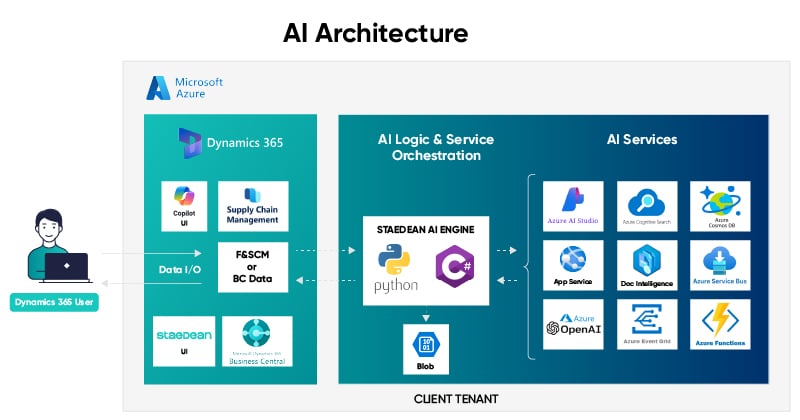
Why the architecture behind AI matters as much as the use case
For organizations in regulated industries, and increasingly for any enterprise running D365 — how AI is delivered matters just as much as what it does.
Instead of moving data outside core systems, AI operates where your business already runs—ensuring security, compliance, and full control.
The most efficient AI agents do not move your data. They work where your data already resides. The AI platform that STAEDEAN offers is built on this principle. We believe that AI should work where your business runs, not outside it.
This means:
-
Your data never leaves your MS Azure tenant environment. AI capabilities run inside your Microsoft Azure tenant. There is no external data transfer and no third-party processing of sensitive information.
-
Your governance stays intact. The platform connects seamlessly into your existing Microsoft D365 workflows, respecting your security boundaries, approval structures, and compliance controls.
-
Your teams adopt AI without introducing new risks. No new tools to learn, no workarounds to manage, and no shadow IT to govern.
A reusable AI architecture — not one-off AI projects
By establishing this reusable architecture, we deliver future AI capabilities on a consistent, trusted foundation instead of creating a separate setup for every use case.
And unlike many AI initiatives in the market that are still built customer by customer, we are taking a product-led approach: standardized, reusable AI capabilities delivered on a common platform foundation and deployable across many customers.
Just as important, this is not a one-time deployment model. As AI services and LLMs evolve, we maintain the solution end-to-end, re-testing, updating, and deploying where needed so you can continue to innovate with confidence over time.
What value do AI agents in Pharma Manufacturing deliver when embedded in ERP systems?
In an enterprise system like Microsoft Dynamics 365 ERP, AI agents can deliver immediate, practical value.
-
Faster ERP setup and configuration
-
Reduced manual workload for quality and operations teams
-
Lower compliance and audit risk
-
More consistent, high-quality data across systems
-
AI that works within your existing processes, not outside them
-
A maintained platform approach that evolves as AI services evolve
How to adopt AI agents in regulated manufacturing without increasing risk?
Adopting AI agents in Pharma is not restricted to being a technology decision. It is also an operational and compliance decision. When AI is not embedded into existing systems and workflows, and introduced as a disconnected layer, there is a high risk that the AI project will not move beyond the pilot.
If you want to adopt AI agents safely without increasing your risk, focus on solving real ERP-driven business problems using real data within controlled environments. This is what we aim to facilitate with the STAEDEAN AI Early Access Program, that is open for our customers.
When you join early, you help shape how the solution works:
-
Your problems get solved first. The AI capabilities are designed around the challenges you actually face – in your workflows, with your data, in your environment.
-
You shape the product. Your feedback directly influences what gets built, how it works, and what comes next.
-
You move ahead with confidence. Not by adding another disconnected AI tool, but by building alongside a team committed to delivering AI that fits the way your business operates.
The future of AI agents in Pharma Manufacturing is embedded, governed, and scalable
Be it Pharma or any other regulated industry that values security, control, and trust, generic standalone AI tools are not sufficient. What is required is AI that is embedded meaningfully, delivered responsibly, and designed around the realities of enterprise operations.
The shift also requires moving beyond one-off customer-specific AI projects. The Pharma industry needs standardized, productized AI capabilities that can be deployed and maintained at scale.
For organizations looking to reduce manual effort, improve compliance, and adopt AI agents within ERP systems without compromising control, the starting point is clear:
AI should work where your business runs — on a reusable, governed architecture — and where your data already lives.
If you are just getting started and are looking for a Life Sciences ERP solution, then reach out to us for a demo.
If you’re an existing customer and exploring how to adopt AI agents in Pharma Manufacturing, consider joining our Early Access Program.


Find out how to adopt AI agents in Pharma Manufacturing.
Monica Ferraioli
